

Decisioning in the Real World
Decisions are everywhere. You've been on the receiving end of them your entire life. The systems making those calls are rarely visible, but they're always running. Here are a few examples across different industries.
Notifications
Product Category: Team Communications
Every message sent in a team communication platform triggers a cascading set of decisions before a single notification is delivered.
Should this message generate a desktop notification? An email? A badge count? Nothing at all? The answer depends on a structured evaluation of rules: the recipient's notification preferences, whether they're mentioned directly or in a watched channel, their current presence status, whether the sender is a bot or a human, the message priority level, and whether do-not-disturb is active.
These rules are not simple. They're layered, user-configurable, and need to be evaluated consistently across millions of concurrent users and messages.
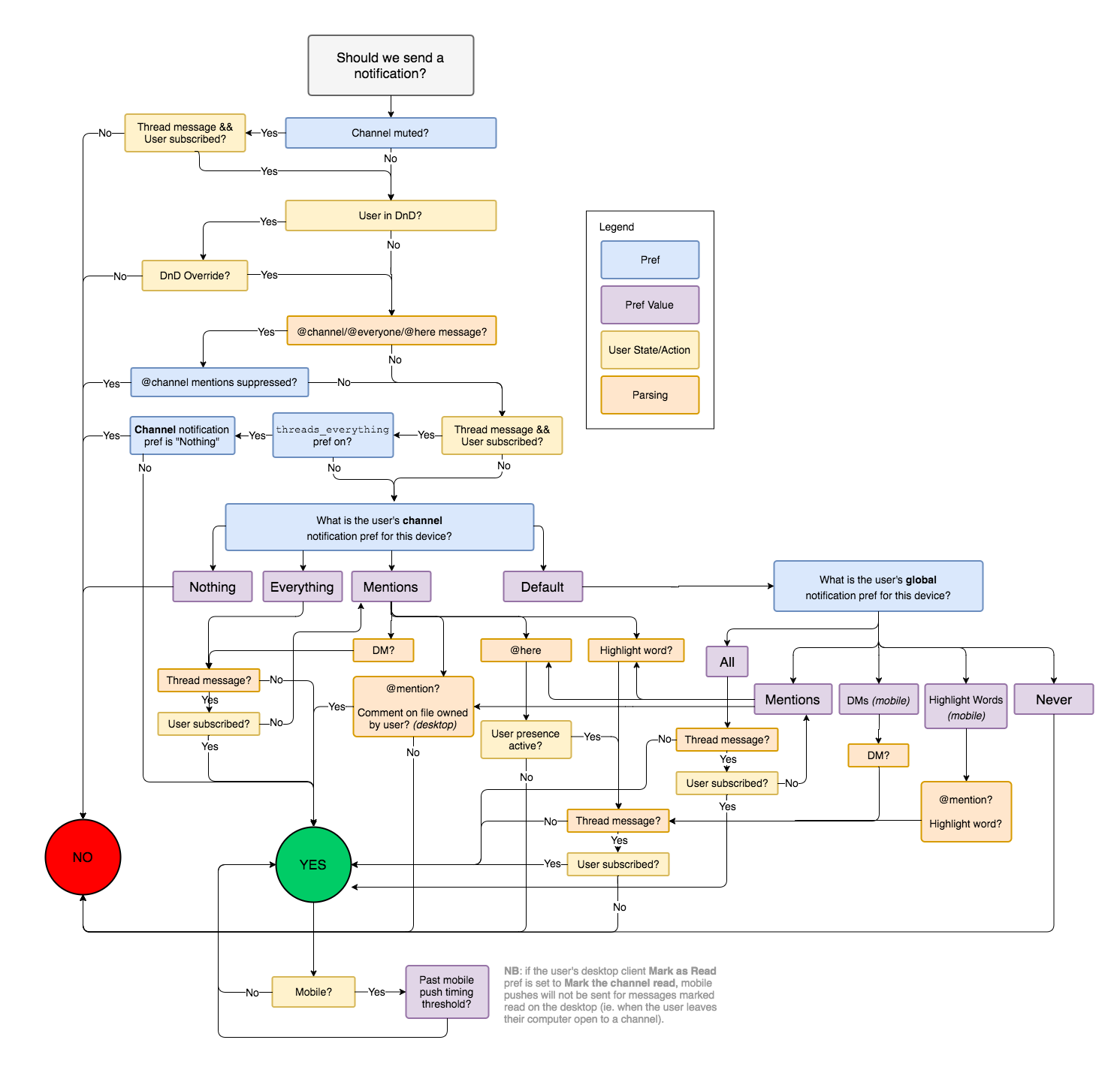 Source: Slack
Slack documented this directly in their engineering blog when they rebuilt their notification infrastructure. To reduce the memory footprint of the desktop app, they moved notification logic from the client to the server — and in doing so, had to explicitly formalise it.
As they described it: "Slack is known for its granular and powerful notification preferences — which is great for customers but meant we needed to migrate a good deal of client-side logic to the server."
The result was a server-side decisioning system that evaluated each incoming message against a full set of user and channel preferences to determine whether a desktop_notification event should be emitted at all. The logic had always existed — it just lived implicitly in client code. Making it explicit, centralised, and server-evaluated was the engineering lift.
You can read Slack's full account here.
Dynamic Pricing
Product Categories: Booking Platforms, E-commerce, Ride-Share
Dynamic pricing is when the price of a good or service is adjusted in real time based on current market conditions, rather than held at a fixed rate. This leverages the fact that price is one of the most effective levers to control both supply and demand. When demand exceeds supply, raising the price discourages lower-priority consumption and attracts additional supply. When supply exceeds demand, lowering the price stimulates consumption and clears inventory.
Airlines have used yield management systems since the 1970s, adjusting fares continuously based on how many seats remain, how quickly they are selling, how close the departure date is, and what competitors are charging. A seat on the same flight can carry dozens of different prices simultaneously, each targeting a different segment of travellers by price sensitivity and booking horizon.
E-commerce platforms use similar logic at scale. Amazon is estimated to update prices across its catalogue millions of times per day, factoring in competitor pricing, stock levels, browsing behaviour, and purchase history.
Hotels, car rentals, event tickets, and cloud computing credits all operate under comparable models.
What all these systems share is a decisioning layer, a set of rules or optimisation objectives that are evaluated continuously against real-time inputs and produce a price. The inputs may vary by industry (remaining inventory, time to fulfilment, demand signals, competitor data) but the goal is the same.
Ride-sharing platforms illustrate a particularly well-documented version of this. Lyft described the evolution of their PrimeTime (PT) pricing algorithm in their engineering blog, framing the core problem not as revenue maximisation but as marketplace balance.
In a two-sided marketplace with perishable supply (driver availability), the challenge is keeping the ratio of riders to available drivers within a range where the service remains functional. Too much demand relative to supply and the service becomes unavailable: no drivers to match, regardless of price. Too little demand and drivers are underutilised, with long wait times caused by geographic dispersion rather than shortage.
 Source: Lyft Engineering Blog
Their decisioning system evaluates real-time inputs like available driver count, ride request rate, estimated wait times, geographic distribution of supply, and rider conversion functions; and outputs a price multiplier calibrated to hold the market at a target equilibrium.
Later iterations of the algorithm moved beyond local supply/demand ratios to solve a constrained network optimisation problem, balancing multiple geographic submarkets simultaneously and accounting for how activity in one area propagates to adjacent areas over time.
You can read Lyft's full account here.
Card Authorizations
Industry: Financial Services
Every time you tap your card, a decisioning engine runs in under 100 milliseconds. It has to. The payment network evaluates your transaction against dozens of rules simultaneously: Is this amount within your available credit? Does this merchant category match your spending history? Is this country or device unusual for you? Has there been a suspicious spike in activity on this card in the last hour?
If the rules say approve, the transaction goes through. If they flag it, you get declined — or a call from your bank. The whole thing happens before the card reader beeps.
This is one of the oldest and most battle-tested decisioning systems in existence. Visa and Mastercard have been running rule-based authorization engines since the 1980s.
Loan Approval
Industry: Lending
When you apply for a loan, a human might review your application — but the first pass is almost always automated. Underwriting engines evaluate your credit score, income, debt-to-income ratio, employment status, loan-to-value ratio, and more, then produce one of three outcomes: approved, declined, or referred for manual review.
Large lenders process thousands of applications a day. Without a decisioning engine evaluating the bulk of them consistently and instantly, the economics don't work. The rules themselves are often regulatory requirements — which means they need to be auditable, versioned, and explainable.
Matchmaking & Scoring
Industry: Gaming
Modern multiplayer games use skill-based matchmaking (SBMM) to decide who plays against whom. In a game like Call of Duty, every completed match feeds data back into a decisioning system: your kill/death ratio, accuracy, score per minute, win rate, recent performance trend. The engine evaluates these inputs against a ruleset and slots you into a skill bracket. When you queue for a match, it finds opponents whose brackets align with yours.
The same principle applies to XP and reward systems — how much you earn per match, when you unlock a new rank, whether you qualify for a seasonal reward — all driven by rule evaluation against your stats.
Players debate endlessly about whether these systems are fair. That debate is itself a sign of how much the rules matter.
Insurance Quoting
Industry: Insurance
When you get a car insurance quote online in under a minute, a decisioning engine is doing the work. It takes your age, postcode, vehicle make and model, years of driving experience, claims history, and annual mileage, then evaluates them against a pricing ruleset to produce a premium.
Different risk profiles hit different rules. A 22-year-old driving a modified hatchback in a dense city triggers a very different set of outcomes than a 45-year-old driving a saloon car in a rural area. The rules encode the insurer's risk appetite — and they get updated regularly as claims data changes what the business considers acceptable risk.
Triage & Patient Routing
Industry: Healthcare
When a patient arrives at an emergency department, clinical staff use a triage protocol to assign a priority level — typically 1 through 5. In many modern hospital systems, this process is partially supported by decisioning software that evaluates presenting symptoms, vital signs, age, and medical history against clinical guidelines to recommend a triage category and flag high-risk cases.
The same logic applies to patient routing: which ward, which specialist, which care pathway. Healthcare decisioning is heavily regulated and always has a human in the loop for final sign-off — but the engine narrows the decision space and surfaces the right information fast, which is the point.
These systems span industries, but they share the same underlying pattern: a structured set of rules, evaluated against structured inputs, producing a consistent and auditable output. That's decisioning.